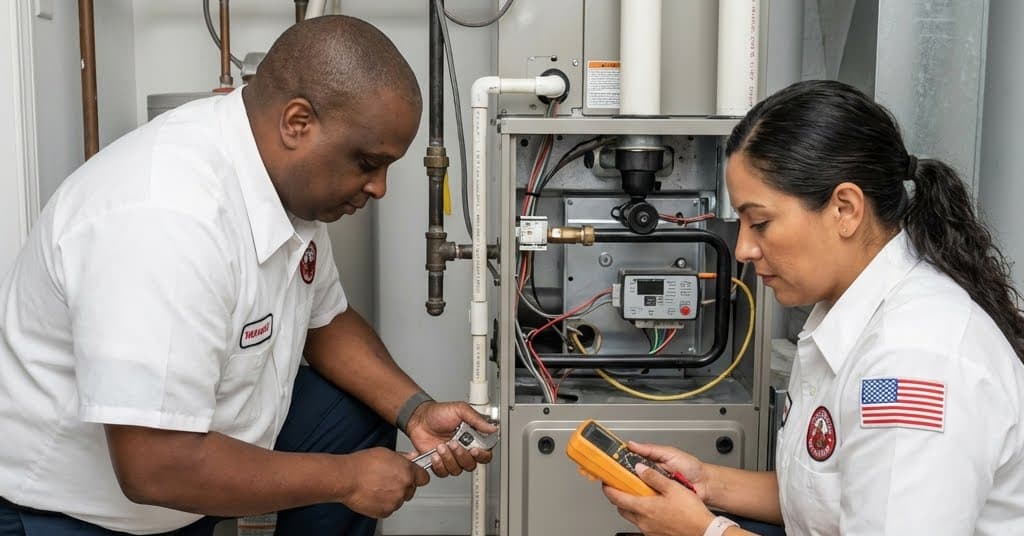
Finding Reliable Water Heater Replacement Services
Most homeowners only search for water heater replacement near them when hot water suddenly fails. In practice, replacement decisions are clearer when you evaluate unit age, warning signs, and operating efficiency before emergency failure.
Planned replacement typically reduces disruption compared with emergency response after a rupture event and helps you compare options without timeline pressure.
5 Signs Your Heater Is Failing
- Popping or knocking sounds from sediment buildup.
- Rust-colored hot water.
- Moisture or puddling at the base.
- Reduced recovery and fading hot water output.
- Unit age over ten years.
Tank vs. Tankless for Busy Households
Standard tanks are often easier to install and lower in upfront cost. Tankless systems reclaim floor space and can deliver steady hot water when correctly sized for household flow demand.
Gas, Electric, or Heat Pump: Operating Cost Considerations
- Gas: strong recovery performance for higher demand.
- Electric: straightforward equipment path for many homes.
- Heat pump: strong long-term efficiency with proper space and electrical setup.
Sizing So You Avoid Another Cold Shower
Use first-hour rating and peak-hour demand together. Choosing by gallons alone can underestimate real usage during high-demand windows.
Vetting Local Plumbers: 4 Questions to Ask
- Will you handle permits and inspection coordination?
- Can you provide active license and liability insurance proof?
- Are code-required expansion and safety components included?
- Is old-unit haul-away included in writing?
Typical Pricing Ranges on Our Site
- Standard tank replacement: $1,800 to $2,800
- Tankless or heat pump replacement: $3,200 to $4,500+
- General replacement range used across pages: $1,800 to $4,500+
3-Step Action Plan
- Record your current tank size and fuel type.
- Clear access around the current unit for inspection.
- Collect three itemized quotes and compare complete scope.
Frequently Asked Questions
When is replacing a water heater smarter than repairing it?
If your unit is near or beyond ten years old and showing rust, leaks, or unstable heat output, replacement is often the safer financial decision. Delays can increase emergency risk and total project cost.
Tank vs. tankless: which is better for my home?
Traditional tanks usually have lower upfront cost and easier swaps. Tankless systems save space and can support long-term value, but require correct flow-rate sizing and a larger initial investment.
Gas, electric, or heat pump: which lowers operating costs most?
Heat pump options often provide the best operating efficiency where installation conditions allow. Gas can support fast recovery, while standard electric can be easier initially but may cost more monthly in some homes.
How do I size a new water heater correctly?
Size for peak-hour usage and check first-hour rating, not just nominal tank gallons. This prevents hot-water shortages during back-to-back morning use.
How do I compare plumbers and quotes?
Verify licensing, insurance, permit handling, and line-item scope details including safety components and haul-away. Compare complete quotes from multiple providers, not just top-line price.
Continue with the main pillar: Drain Cleaning South San Francisco, CA.