Dealing with tree roots in your sewer line is one of the most common and frustrating plumbing problems for Bay Area homeowners. If your drains are backing up, gurgling, or slowing down, root intrusion could be the cause. In this complete sewer line root removal guide, Sugar Bear Home Services walks you through every method available -- from simple DIY fixes to professional solutions -- so you know exactly how to get rid of roots in sewer line pipes and restore proper water flow.
Why Roots Grow Into Sewer Lines
Tree roots grow toward moisture and nutrients. Your sewer line carries warm, nutrient-rich water underground, which makes it an irresistible target for nearby root systems. Even a hairline crack or loose pipe joint releases enough moisture into the surrounding soil to attract root growth from several feet away.
Once a small root tendril finds its way inside, the ideal growing conditions cause rapid expansion. The root forms a net-like mass that catches debris, toilet paper, and grease. Over time, this mass can completely block water flow and even crack the pipe further, allowing more roots to enter.
Bay Area homes are especially vulnerable because of the region's mature urban tree canopy and the number of older homes with clay or cast iron pipes. These aging pipe materials develop cracks as they corrode, providing easy entry points for aggressive root systems.
Signs You Have Roots in Your Sewer Line
Before jumping into sewer line root removal methods, confirm that roots are actually the problem. Watch for these warning signs:
- Slow drains throughout the home. When multiple fixtures drain slowly at the same time, the blockage is likely in the main sewer line rather than a single branch.
- Gurgling sounds from toilets or drains. Roots that partially block the pipe trap air, which creates gurgling noises when water tries to pass through.
- Recurring clogs. If you keep clearing the same drain and it backs up again within weeks, root growth inside the pipe is a likely cause.
- Sewage odors in the yard or home. Roots that crack your pipe can release sewer gas into the surrounding soil and up through the ground.
- Lush green patches in your yard. If one section of grass looks noticeably greener than the rest, a leaking sewer line may be fertilizing it from below.
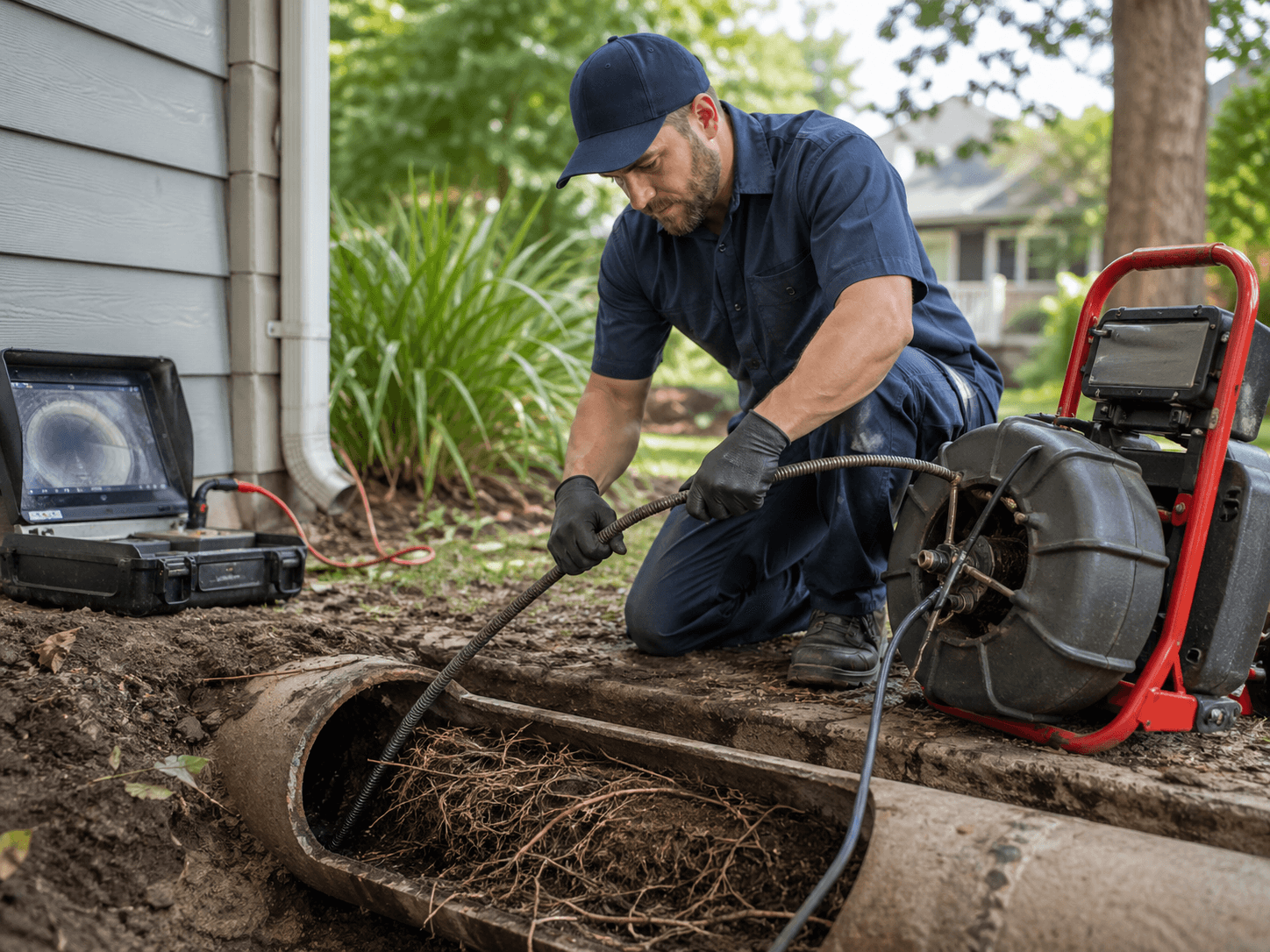
A sewer camera inspection is the only way to confirm root intrusion with certainty. A plumber feeds a small HD camera through the pipe to visually identify the location, severity, and type of blockage.
DIY Methods: How to Get Rid of Roots in Sewer Line Pipes
Several DIY methods can help with minor root intrusion or serve as maintenance between professional cleanings. Here are your options.
Chemical Root Killers
Copper sulfate crystals are the most common chemical root killer available at your local hardware store. You flush about half a cup of copper sulfate down the toilet closest to the main sewer line, and it slowly kills roots on contact as it passes through the pipe.
Pros: Inexpensive, easy to apply, and effective for killing small root tendrils.
Cons: Copper sulfate is toxic to aquatic life and banned in some municipalities. It also does not remove dead roots from the pipe -- it only kills living tissue. Repeated use can corrode metal pipes over time.
Foaming Root Killer
Foaming root killer products (such as RootX) expand to fill the entire pipe diameter when flushed. The foam coats roots above and below the water line, which kills roots more effectively than copper sulfate alone. You can find these products at your local hardware store or order them online.
Pros: Treats roots above the waterline that copper sulfate misses. Designed to kill roots without harm to the pipe itself when used as directed.
Cons: More expensive than copper sulfate. Still a temporary solution that does not address the underlying pipe damage.
Rock Salt
Flushing rock salt down the toilet is an old-school method to kill roots. The salt draws moisture out of root tissue through osmosis, eventually killing it.
Pros: Extremely cheap and widely available.
Cons: Salt can corrode pipes and kill roots without harm is not guaranteed -- heavy use can damage surrounding vegetation and soil. It is the least effective option and works very slowly.
Mechanical Root Cutter (Drain Auger)
A root cutter attachment on a drain auger physically chews through root masses inside the pipe. Handheld drain augers are available for rent, but a root cutter attachment powerful enough for main sewer lines requires a motorized machine.
Pros: Physically removes roots and immediately restores water flow.
Cons: Requires experience to avoid damaging pipes. Consumer-grade machines may lack the power needed for heavy root masses. The root cutter only clears a path through the center of the blockage and does not clean the pipe walls.
Professional Sewer Line Root Removal Methods
For serious root intrusion or recurring problems, professional intervention delivers better results and protects your pipes. Here are the methods professionals use.
High Pressure Water Jetting (Hydro Jetting)
Hydro jetting is the gold standard for professional sewer line root removal. A specialized nozzle connected to a high pressure water pump blasts roots, debris, and buildup out of the pipe at 3,000 to 4,000 PSI. Forward-facing jets break through the blockage, while rear-facing jets scour the pipe walls clean and propel the hose forward.
The result is a pipe cleaned to near-original condition -- not just a hole punched through the middle of a root mass. Hydro jetting restores full water flow and typically keeps pipes clear for one to four years depending on conditions.
Cost: $650 to $1,200 in the Bay Area for residential service.
Best for: Heavy root intrusion, grease buildup, recurring clogs, and pre-pipe-lining preparation.
Professional Mechanical Snaking
A licensed plumber uses a heavy-duty motorized auger with a root cutter blade to break through root masses. Professional-grade machines are far more powerful than consumer rentals and can handle root balls that fill the entire pipe.
Cost: $250 to $450 in the Bay Area.
Best for: Emergency situations where immediate flow restoration is the priority, and for pipes too fragile to handle high pressure water.
Sewer Camera Inspection
Before any root removal work, a professional will typically run a sewer camera inspection to assess the pipe's condition, locate the root intrusion, and determine the best approach. This prevents unnecessary damage from using the wrong method on fragile pipes.
Cost: $350 to $500 in the Bay Area.
How to Kill Roots in Sewer Line Without Damaging Your Pipes
One of the most common concerns homeowners have is how to kill roots without harm to the surrounding pipe. Here are the safest approaches ranked from least to most aggressive:
- Foaming root killer -- The gentlest chemical option. Designed specifically to kill roots without harm to pipe materials when used according to directions.
- Copper sulfate -- Effective but should be used sparingly on metal pipes. Safe for PVC.
- Professional hydro jetting at controlled pressure -- An experienced operator adjusts the water pressure based on your pipe material. Cast iron and clay pipes require lower settings than PVC.
- Mechanical root cutter -- Safe when operated by an experienced plumber who can feel the difference between cutting roots and cutting pipe.
Avoid using harsh chemical drain cleaners (like Drano or Liquid-Plumr) for root problems. These products are designed for organic clogs like hair and grease, not roots. They generate heat and corrosive reactions that can weaken already damaged pipes.
Preventing Root Growth in Your Sewer Line
After sewer line root removal, preventive measures keep your pipes clear longer and save you money on repeat service calls.
Regular Maintenance Treatments
Flushing a foaming root killer through your sewer line once or twice a year slows new root growth inside the pipe. This is especially important if you have large trees near your sewer line and older pipe materials.
Root Barriers
Physical root barriers are sheets of slow-release chemicals or solid materials buried between trees and your sewer line. They redirect root growth away from the pipe without harming the tree. A professional can install these during any excavation work near your sewer line.
Pipe Lining (Trenchless Repair)
If your pipe has cracks or damaged joints that allow roots to enter, patching the entry point is the only permanent solution. Trenchless pipe lining (CIPP) creates a seamless new pipe inside your existing one. The smooth interior eliminates the joints and cracks that attract root growth in the first place.
Annual Camera Inspections
Scheduling an annual sewer camera inspection catches new root growth early, when a simple maintenance treatment can handle it. Waiting until you have a full backup means you need more aggressive (and expensive) sewer line root removal methods.
Smart Landscaping
When planting new trees, choose species with less aggressive root systems and keep them at least 10 feet from your sewer line. In the Bay Area, avoid planting Monterey Pine, Eucalyptus, or Fig trees near underground utilities -- these species are notorious for aggressive root growth that targets sewer pipes.
When to Call a Professional for Sewer Line Root Removal
DIY methods work well for minor root intrusion and preventive maintenance. But some situations require professional help:
- Multiple drains are backing up simultaneously. This signals a main sewer line blockage that consumer tools cannot reach effectively.
- You have cleared the same clog more than twice in six months. Recurring problems mean the underlying pipe damage needs professional assessment.
- Your home has clay or cast iron pipes. These fragile materials require careful handling that DIY methods cannot guarantee.
- You see sewage in your yard or basement. A major blockage or pipe break needs immediate professional sewer line root removal.
- Your home is more than 25 years old and has never had a sewer inspection. A camera inspection can reveal developing problems before they become emergencies.
Trust Sugar Bear Home Services for Sewer Line Root Removal
At Sugar Bear Home Services, we handle sewer line root removal for homes throughout the San Francisco Bay Area -- including San Francisco, Daly City, South San Francisco, San Bruno, Pacifica, San Mateo, and Sausalito. Our licensed plumbers use sewer camera inspections to diagnose the problem accurately, then recommend the most effective solution for your specific pipe material and situation.
Whether you need high pressure water jetting to blast out a heavy root mass, a root cutter to restore immediate flow, or trenchless pipe lining to permanently seal your pipes against future root growth, we have the equipment and expertise to get it done right.
Contact Sugar Bear Home Services today at (650) 618-9680 to schedule a sewer camera inspection and keep your pipes root-free.